 Tinyverse

How to write a social narrative your child will actually want to read
A good social narrative describes a moment calmly, from your child's side of it, and ends with something they can feel good about. Here is how to write one, page by page, with a real example you can copy.
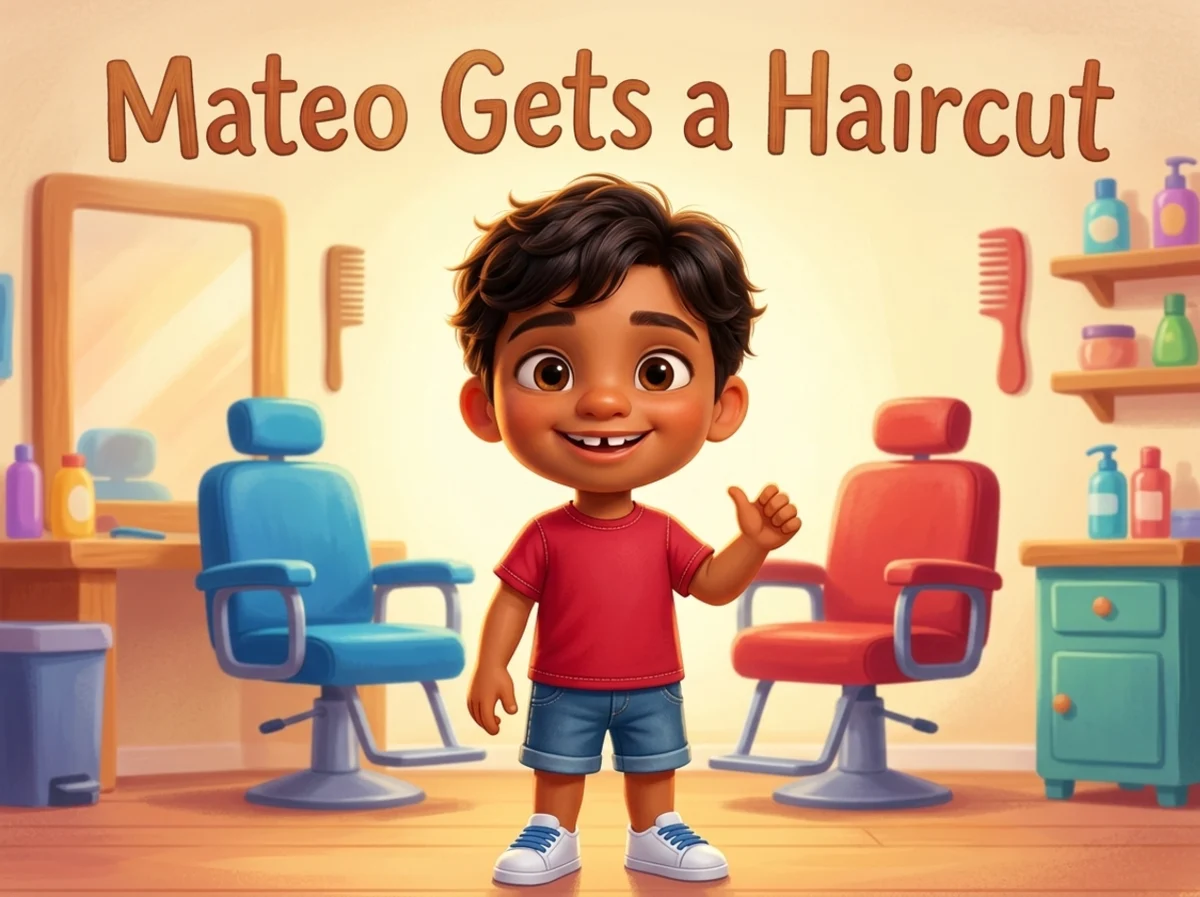
To write a social narrative, pick one specific moment your child finds hard, write it from your child's point of view in short, calm sentences, describe what happens and how others might feel, add one or two gentle coaching sentences, and end on something your child can feel proud of. Keep it to 6 to 10 pages with one idea per page, and read it together before the moment happens, not during it.
Key takeaways
- One story covers one moment. "Getting a haircut" works. "Being good in public" does not.
- Most sentences should describe. A common guideline is at least two describing sentences for every coaching sentence.
- Write in your child's voice ("I sit in the big chair"), stay positive, and avoid "never," "must" and "don't."
- Read it calmly and often before the event. A story read in the middle of a meltdown rarely lands.
- Pictures that look like your child and their real places make the story easier to connect to.
What is a social narrative?
A social narrative is a short, illustrated narrative that walks a child through a specific situation before it happens: what they will see, what other people are doing, and one or two things they can try. Clinicians and researchers usually call the practice a social narrative. The National Clearinghouse on Autism Evidence and Practice lists social narratives among its evidence-based practices for autistic children and youth, and UNC's free AFIRM module on social narratives is a good place to see how schools are trained to use them.
The goal of a social narrative is understanding. Behavior change, when it comes, follows from the child knowing what to expect.
How do you write a social narrative, step by step?
- 1
Pick one moment, and say it precisely
Watch for the moment where things go wrong. Write it down as a scene, with a place and a time. "Getting a haircut at Ana's shop on Saturday" gives the story a place and a time. "Being brave" gives it neither.
- 2
Find out what is underneath it
Is it the buzz of the clippers, the cape on the neck, not knowing when it ends? The story should answer the thing your child is actually worried about.
- 3
Write the describing pages first
Where are we, who is there, what will I hear and feel, what happens next. These pages lower the unknowns, and they should be most of the story.
- 4
Add the perspective of other people
Write a page like "Ana wants my hair to look nice." It helps a child read the room without being told what to do.
- 5
Add one or two coaching sentences
Phrase them as options, in the child's voice. "I can hold my car while Ana cuts." Avoid "I will not cry."
- 6
End with a celebration
The last page should feel good. "My haircut is done. I did it." That is the line your child remembers.
- 7
Read it before, often, and calmly
Read it the day before and the morning of. Leave it where your child can find it. Retire it when the moment is no longer hard.
A full social narrative example, page by page
Here are six real pages from Mateo Gets a Haircut, a story made in Tinyverse. Each page is tagged with the job its sentences are doing, so you can see the balance. Most of the story describes, and only one page coaches.
Mateo Gets a Haircut (real pages)
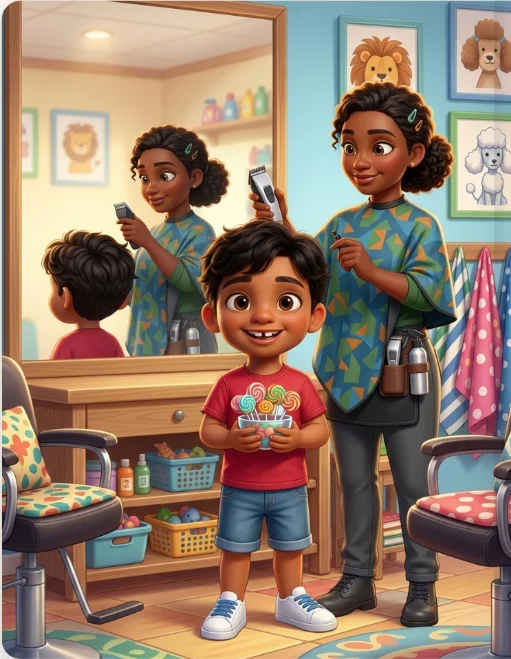
I am Mateo. Today I am going to the hair salon. My hair gets shorter when I get a haircut.
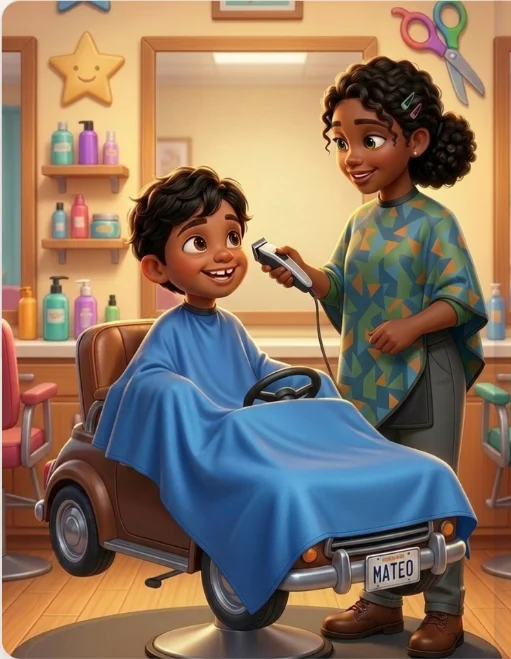
The clippers make a buzzing sound near my ears. Some kids like that sound and some kids do not.
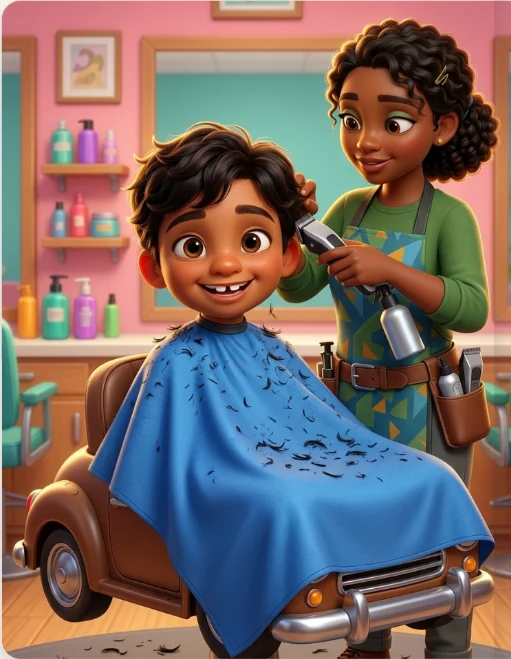
Small pieces of hair fall onto the cape. Sometimes hair lands on my neck. That happens to everybody at the salon.
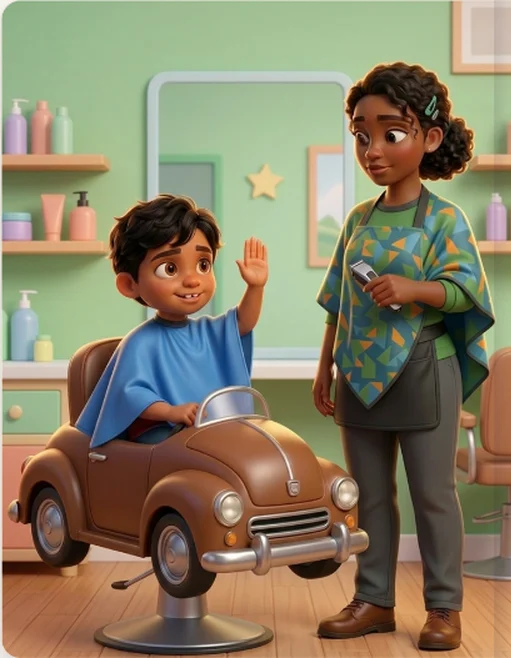
If something feels like too much, I can say "stop" or raise my hand. The stylist will wait for me.
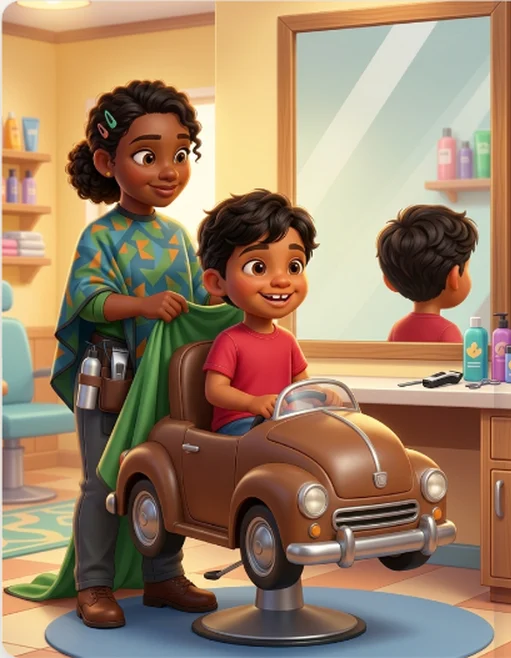
The stylist takes off the cape. My haircut is finished. I can look in the mirror if I want to see.
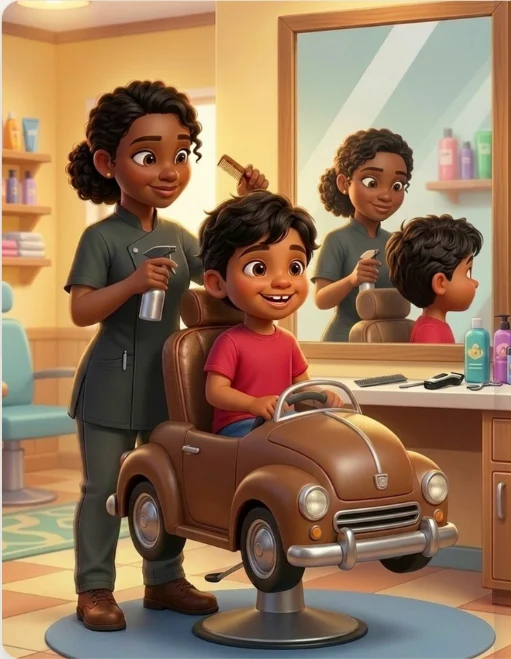
Some haircuts feel easy and some feel hard. This one is done. I am doing a great job today.
Notice what is missing. There is no "I will sit still," no "I will not cry," no list of rules. The story names the sensations honestly (the buzz, the hair on the neck), gives one concrete thing to do, and ends on pride.
Your first story is free
Upload one photo, describe the moment your child is working through, and get an illustrated social narrative with your child as the hero in about 2 minutes.
Which sentence types go into a social narrative?
You will see different names for these in different trainings. The jobs are what matter.
| Sentence type | What it does | Example |
|---|---|---|
| Describing | States facts about the setting and what happens | The shop has big chairs that go up and down. |
| Perspective | Shares what someone else thinks or feels | Ana wants my hair to look nice. |
| Coaching | Offers one thing the child can try | I can hold my car while Ana cuts. |
| Affirming | Reassures or names a shared value | Lots of kids feel nervous at the barber. That is okay. |
| Celebrating | Ends on success and pride | My haircut is done. I did it. |
Keep coaching sentences rare and phrased as options. If a story has more coaching than describing, it is a rule sheet with pictures.
How long should a social narrative be?
For most children ages 2 to 5, aim for 4 to 6 pages with one short sentence each. For ages 6 to 12, 6 to 10 pages with one or two sentences works well. Match your child's reading level, then go a little shorter than you think. The story should take less than three minutes to read aloud.
Do social narratives need pictures?
They do not strictly need them, and some older readers prefer text. For younger children and for kids who think visually, pictures carry most of the meaning, and the closer the picture is to real life, the easier the connection. A drawing of a barber shop is helpful. A drawing of your child in their barber shop, wearing their own clothes, is much easier to step into. That gap is the reason I started building Tinyverse.
Mistakes that make social narratives backfire
Before you print, check for these
- Too many rules. If most sentences say what to do, rewrite until most of them describe.
- Negative wording. Swap "I will not hit" for "I can squeeze my hands or ask for space."
- Promises the world cannot keep. Write "the dentist will probably count my teeth" instead of "it will not hurt."
- Using it as a consequence. A story read only after a bad moment starts to feel like punishment. Read it at calm times.
- One story for everything. Make a separate story for each moment. They are quick to read and easier to retire.
How to read a social narrative with your child
Read it a few times before the event, at a calm time of day, and let your child hold the pages. Point to the pictures. Pause on the coaching pages and practice them for real: raise a hand, take a breath. After the event, read the last page again together. If your child asks for the story on their own, that is a good sign it is doing its job. Our guide to whether social narratives work covers how to tell, and the social narrative examples page has more situations to start from.
Questions parents and teachers ask
What is the difference between a social story and a social narrative?
They describe the same practice. "Social narrative" is the term used in the research and in school training materials. Many parents and teachers call them social stories.
Should a social narrative be written in first person?
For most young children, yes. Writing in the child's voice ("I sit in the big chair") helps them picture themselves in the moment. For some older children or teens, third person feels less awkward. Use whichever your child responds to.
How often should I read a social narrative?
A common pattern is once a day for several days before the event, plus once right before it. For daily routines, read it at the same calm time each day for a week or two, then taper off.
Can I write a social narrative for a behavior like hitting?
Yes, as long as the story describes the situation and offers a better option, instead of listing what not to do. See our guide to social narratives for hitting and safe hands.
Is there a social narrative template I can use?
The seven steps above work as a template: one page for the setting, a few pages describing what happens, one page of someone else's perspective, one or two coaching pages, and a celebration page. Tinyverse builds that structure for you from a short description of the moment.

Your first story is free
Upload one photo, describe the moment your child is working through, and get an illustrated social narrative with your child as the hero in about 2 minutes.
Work in a school or clinic? Request a school pilot or get a clinic quote.
How this was made: written by Dilip Jagadeesh with AI drafting help, then checked against the sources linked in the article. The illustrations are real Tinyverse output or mockups of Tinyverse visual supports. Nothing here is medical advice; talk with your child's care team about what fits your child.